
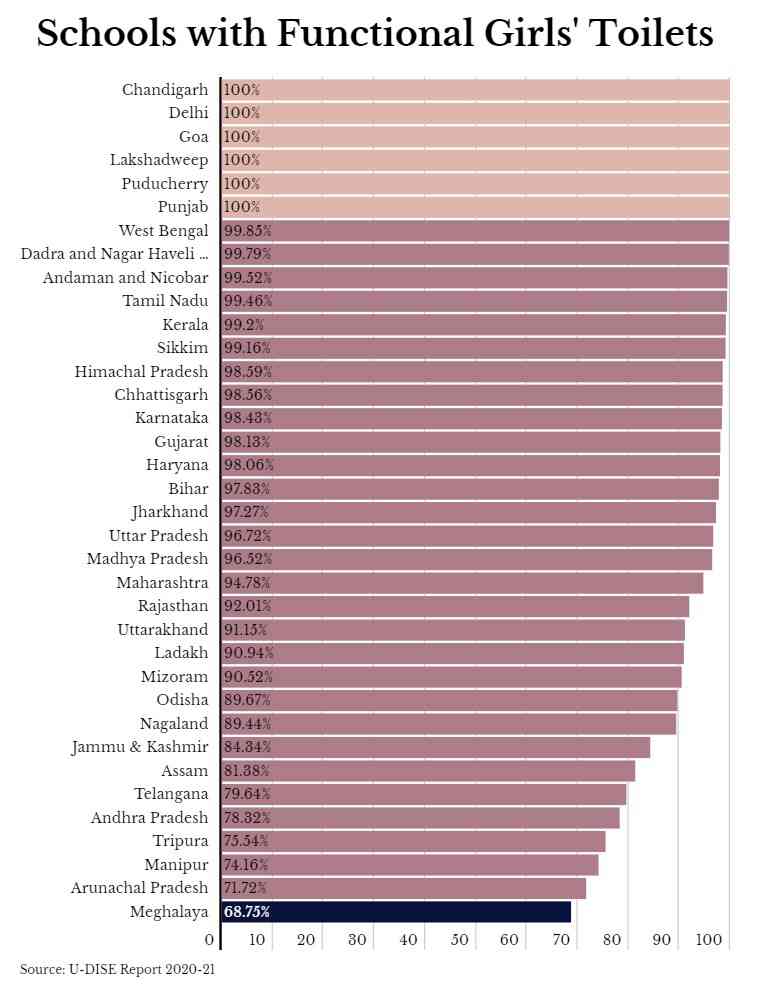
The Union government has informed Parliament that a vast majority of schools across India now have separate toilets for girls, marking a significant milestone in infrastructure development under flagship education and sanitation programmes. However, the statement has also triggered a critical question: who is responsible for maintaining these facilities on a daily basis?
According to the government’s reply, the construction of girls’ toilets in government and aided schools has reached near-universal coverage, a key objective under initiatives such as Swachh Bharat Abhiyan and Samagra Shiksha. Officials argue that access to toilets has played an important role in improving girls’ enrolment and retention, especially at the secondary level.
Yet, ground reports from several states suggest that availability does not always translate into usability. Teachers, parents, and education activists point out that many toilets remain locked, poorly maintained, or unusable due to lack of water supply, cleaning staff, and repair funds. In rural and semi-urban schools, teachers are often informally tasked with overseeing sanitation, adding to their already heavy workload.
The issue of maintenance falls into a grey area between departments. While education departments fund construction, regular cleaning and upkeep are typically left to local bodies or school management committees, many of which lack resources. Contractual sanitation workers, where appointed, face delayed payments and job insecurity, leading to inconsistent services.
Experts warn that poor sanitation directly affects girls’ attendance, dignity, and health, particularly during menstruation. “A toilet that exists only on paper does not serve its purpose,” said a senior education researcher, stressing that sanitation must be treated as a recurring expense, not a one-time achievement.
Opposition members in Parliament have demanded clearer accountability and dedicated budget allocations for maintenance, not just construction. They argue that without sustained funding and monitoring, the gains made in infrastructure risk being reversed.
As India pushes for higher female school participation and lower dropout rates, policymakers face growing pressure to move beyond statistics. The real test lies not in how many toilets are built, but in how many are clean, functional, and safe for daily use.