
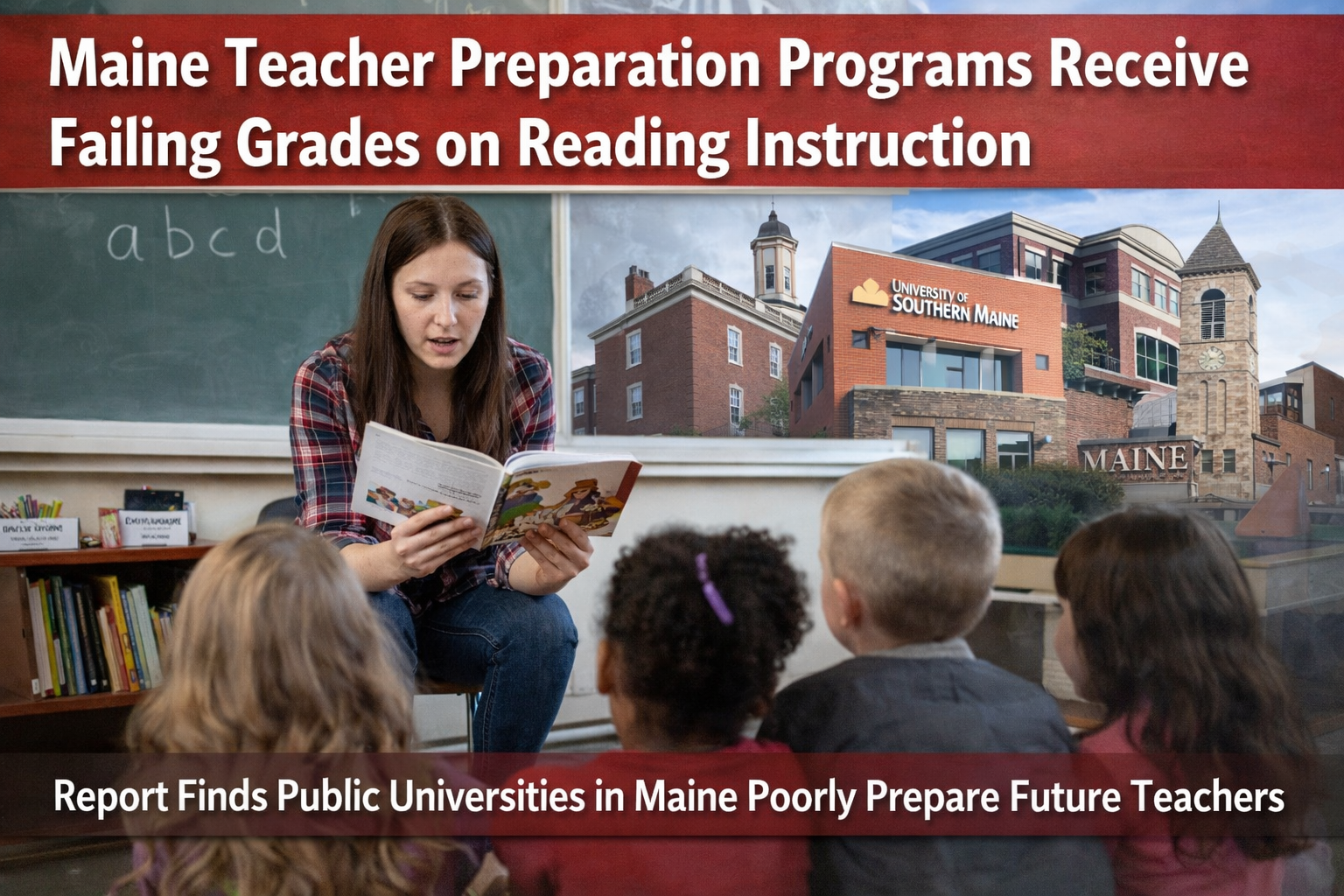
Orono, Maine – January 12, 2026 — In a sharply critical assessment that is reverberating through Maine’s education community, three of the state’s major public universities received failing grades for their teacher preparation programs’ approach to teaching reading, according to a nationwide review of literacy instruction practices.
The National Council on Teacher Quality (NCTQ), a Washington D.C.–based education policy organization, evaluated elementary teacher preparation programs across the United States in 2023 and concluded that the programs at University of Maine in Orono, University of Southern Maine, and University of Maine at Farmington were inadequately preparing future educators to teach essential reading skills to children.
The evaluation focused on how well programs covered the five pillars of effective reading instruction—phonemic awareness, phonics, fluency, vocabulary, and comprehension—widely recognized by researchers as critical components of literacy education. According to the report, none of the Maine campuses sufficiently addressed all five pillars; University of Southern Maine and University of Maine at Farmington did not adequately teach any of the components, while the University of Maine in Orono addressed only comprehension to an acceptable degree.
“We are not serving Maine students well when our teachers who teach in Maine are not prepared in line with our best science,” said Heather Peske, president of the National Council on Teacher Quality, underscoring concerns about Maine’s preparation of new teachers.
University officials from the University of Maine System have strongly rejected the ratings, disputing the methodology and arguing that the report relied heavily on course materials rather than direct observations of instruction and learning. A system spokesperson stated that the findings were “deeply misleading,” pointing to accreditation and state approval for their programs.
The debate over preparation quality comes amid broader concerns about reading proficiency in Maine schools. Recent national assessment data showed that a substantial portion of students struggle with basic reading comprehension—a reality advocates say places even greater importance on how future teachers are trained.
Supporters of evidence-based literacy instruction argue that scientifically grounded reading methods, such as phonics and phonemic awareness, are essential for improving outcomes; critics of the NCTQ findings caution that teaching practices and program strengths cannot be fully captured through syllabus review alone.
As discussions continue within Maine’s universities and among education stakeholders, the spotlight on teacher preparation and literacy instruction is likely to intensify, with implications for future policy, teacher training practices, and student achievement across the state.