
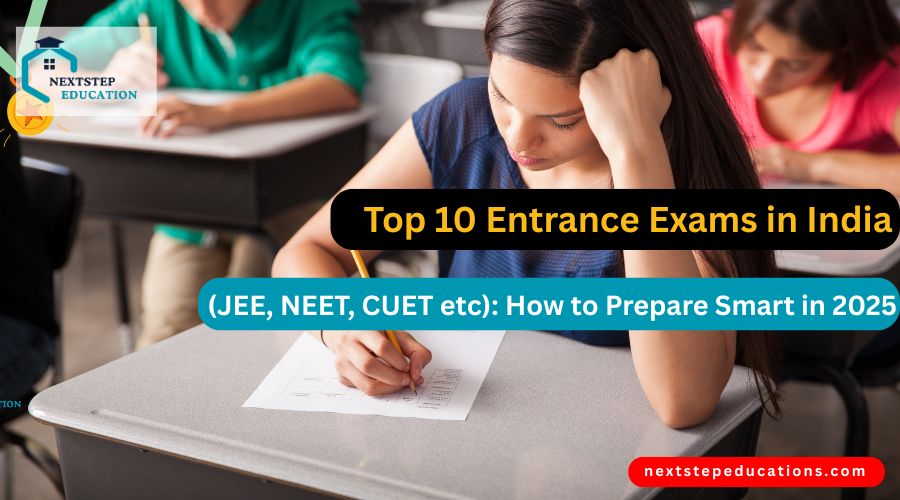
Every year, millions of students across India prepare for competitive entrance exams — the gateways to top universities and dream careers. Whether it’s engineering, medicine, management, or law, entrance exams determine where students begin their higher education journey.
In 2025, the landscape of exam preparation is changing fast. With AI-powered study tools, adaptive mock tests, and hybrid learning methods, students now have smarter ways to prepare. But with rising competition, choosing the right exam and understanding how to study efficiently has become more important than ever.
This guide brings you the Top 10 Entrance Exams in India for 2025 — including JEE, NEET, CUET, CAT, UPSC, CLAT, and more — along with smart preparation tips to help you perform your best.
Why Entrance Exams Matter in 2025
Entrance exams are more than just tests — they’re opportunities to unlock your academic and professional future. In India, they form the foundation of admissions to prestigious institutions like the IITs, AIIMS, NITs, IIMs, and National Law Universities (NLUs).
In 2025, technology is reshaping how students prepare and perform. Digital platforms and AI learning assistants now personalize revision schedules, track progress, and even suggest topics based on your weak areas.
Beyond academic success, cracking these exams teaches discipline, focus, and problem-solving skills that stay valuable for life.
Top 10 Entrance Exams in India (2025)
Let’s look at the most popular and competitive exams that define the academic roadmap for Indian students in 2025.
1. JEE Main & JEE Advanced (Engineering)
The Joint Entrance Examination (JEE) is the primary exam for admission to top engineering institutes in India, including the IITs, NITs, and IIITs. JEE Main serves as the preliminary stage, while JEE Advanced opens the gates to the IITs.
Conducting Body:
-
JEE Main: National Testing Agency (NTA)
-
JEE Advanced: One of the IITs (rotational basis)
Eligibility:
-
Candidates must have completed or be appearing for Class 12 with Physics, Chemistry, and Mathematics.
-
There are specific age and attempt limits depending on the exam stage.
Exam Pattern:
-
JEE Main: 3 sections – Physics, Chemistry, Mathematics
-
JEE Advanced: 2 papers testing analytical, reasoning, and application skills
Important Dates (2025):
-
JEE Main: January & April sessions
-
JEE Advanced: May 2025 (tentative)
- Smart Preparation Tips:
Focus on NCERT fundamentals first
Take timed mock tests regularly
Use AI-based tools like Embibe or ChatGPT to analyze weak topics
Revise through concept videos and problem-based learning
2. NEET-UG (Medical Entrance Exam)
The National Eligibility cum Entrance Test (NEET-UG) is India’s single gateway for MBBS, BDS, and other medical courses in government and private colleges.
Conducting Body:
-
National Testing Agency (NTA)
Eligibility:
-
Students must have completed or be appearing for Class 12 with Physics, Chemistry, and Biology.
-
Minimum age: 17 years
Exam Pattern:
-
Objective (MCQ) format with 180 questions (PCB subjects)
-
Duration: 3 hours 20 minutes
Important Dates (2025):
-
Expected in May 2025
- Smart Preparation Tips:
Prioritize NCERT Biology — it covers 70% of the paper
Create daily revision notes for diagrams & terminologies
Use AI flashcards or apps like Anki for fast recall
Practice full-length mock tests weekly
3. CUET-UG (Common University Entrance Test)
The CUET (Common University Entrance Test) has become the gateway for admissions into central, state, and private universities across India, including Delhi University, BHU, and Jamia Millia Islamia.
Conducting Body:
-
National Testing Agency (NTA)
Eligibility:
-
Students who have completed Class 12 from a recognized board are eligible.
Exam Pattern:
-
Divided into 3 sections:
-
Language Test
-
Domain-Specific Subjects
-
General Test (Logical Reasoning, GK, Quantitative Aptitude)
-
Important Dates (2025):
-
Application: February 2025
-
Exam: May 2025
Smart Preparation Tips:
Understand your target university’s required subjects
Practice comprehension and reasoning daily
Use AI question banks for adaptive quizzes
Revise NCERT + previous year papers
4. CAT (Common Admission Test – MBA Entrance)
The CAT (Common Admission Test) is India’s most prestigious management entrance exam for admission into the Indian Institutes of Management (IIMs) and other top B-schools like FMS Delhi, SPJIMR, and MDI Gurgaon.
Conducting Body:
-
Indian Institutes of Management (IIMs) on a rotational basis
Eligibility:
-
A bachelor’s degree with at least 50% marks (45% for SC/ST/PwD)
-
Final-year students are also eligible
Exam Pattern:
-
Computer-based test with three sections:
-
Verbal Ability and Reading Comprehension (VARC)
-
Data Interpretation and Logical Reasoning (DILR)
-
Quantitative Aptitude (QA)
-
-
Duration: 2 hours
Important Dates (2025):
-
Notification: July 2025
-
Exam: November 2025
Smart Preparation Tips:
Practice daily reading (editorials, business journals) to improve VARC
Analyze at least one mock test per week
Use AI-based analytics tools (like Career Launcher SmartCAT) to track weak areas
Focus on accuracy – not just speed
5. UPSC Civil Services Examination
The Union Public Service Commission (UPSC) Civil Services Exam is one of India’s toughest and most respected competitive exams. It selects candidates for top administrative roles like IAS, IPS, IFS, and IRS.
Conducting Body:
-
Union Public Service Commission (UPSC)
Eligibility:
-
Bachelor’s degree from a recognized university
-
Age limit: 21 to 32 years (with relaxation for reserved categories)
Exam Pattern:
-
Prelims: Objective-type screening test
-
Mains: Descriptive written exam
-
Interview: Personality test
Important Dates (2025):
-
Prelims: June 2025
-
Mains: September 2025
Smart Preparation Tips:
Read The Hindu or Indian Express daily for current affairs
Use AI summarizers to condense lengthy news and reports
Make handwritten notes from NCERTs and standard books
Solve previous year papers to understand question trends
6. GATE (Graduate Aptitude Test in Engineering)
The GATE exam is a national-level entrance test for postgraduate admissions in engineering, science, and technology. It’s also used by PSUs (Public Sector Undertakings) for recruitment.
Conducting Body:
-
Jointly organized by IITs and IISc Bangalore
Eligibility:
-
Bachelor’s degree in engineering, technology, or related fields
-
Final-year students can also apply
Exam Pattern:
-
Computer-based test
-
Consists of 65 questions (MCQ & numerical)
-
Duration: 3 hours
Important Dates (2025):
-
Application: August 2024
-
Exam: February 2025
Smart Preparation Tips:
Focus on conceptual understanding, not just formulas
Revise engineering mathematics regularly
Attempt topic-wise mock tests to boost confidence
Use AI-based practice apps for real-time feedback
7. CLAT (Common Law Admission Test)
The CLAT (Common Law Admission Test) is the national-level entrance exam for students aspiring to study law at National Law Universities (NLUs) and other top law schools in India.
Conducting Body:
-
Consortium of National Law Universities (NLUs)
Eligibility:
-
Candidates must have completed or be appearing for Class 12 with at least 45% marks (40% for SC/ST).
-
No upper age limit.
Exam Pattern:
-
Objective (MCQ) format
-
Sections: English Language, Current Affairs, Legal Reasoning, Logical Reasoning, Quantitative Techniques
-
Duration: 2 hours
Important Dates (2025):
-
Application: July–October 2024
-
Exam: December 2024
Smart Preparation Tips:
Read newspapers daily to improve GK & legal reasoning
Practice comprehension-based questions
Attempt daily mocks and analyze performance
Focus on understanding rather than memorization
8. NIFT Entrance Exam (Fashion & Design)
The NIFT (National Institute of Fashion Technology) Entrance Exam is for students aspiring to pursue fashion design, communication, and technology programs at India’s premier fashion institutions.
Conducting Body:
-
National Institute of Fashion Technology (NIFT)
Eligibility:
-
Passed or appearing in Class 12 from a recognized board
-
No upper age limit for postgraduate courses
Exam Pattern:
-
CAT (Creative Ability Test) and GAT (General Ability Test)
-
For design programs, candidates also face Situation Test / Personal Interview
Important Dates (2025):
-
Application: November 2024
-
Exam: February 2025
Smart Preparation Tips:
Build creativity and sketching practice daily
Stay updated with fashion trends and design basics
Solve previous year papers for pattern familiarity
Use AI image-based tools for idea generation
9. NDA & CDS (Defense Services Exams)
The NDA (National Defense Academy) and CDS (Combined Defence Services) exams are conducted for entry into India’s Army, Navy, and Air Force academies. These exams are perfect for students who dream of serving the nation.
Conducting Body:
-
Union Public Service Commission (UPSC)
Eligibility:
-
NDA: Class 12 passed/appearing (male & female candidates)
-
CDS: Bachelor’s degree from a recognized university
Exam Pattern:
-
Written Test + SSB Interview + Medical Examination
-
NDA: Mathematics & General Ability Test
-
CDS: English, General Knowledge, and Elementary Mathematics
Important Dates (2025):
-
NDA (I): April 2025
-
NDA (II): September 2025
-
CDS (I): February 2025
-
CDS (II): September 2025
Smart Preparation Tips:
Focus on current affairs and general awareness
Practice previous year question papers regularly
Improve physical fitness and communication skills
Use AI-based quiz apps for GK revision
10. AIIMS & IISER Entrance Exams (Science & Research)
The AIIMS (All India Institute of Medical Sciences) and IISER (Indian Institutes of Science Education and Research) conduct separate entrance exams for top science and research-oriented programs in India.
Conducting Body:
-
AIIMS: National Medical Commission (via NEET)
-
IISER: IISER Aptitude Test (IAT)
Eligibility:
-
Class 12 in Science stream with Physics, Chemistry, Biology/Maths
-
Minimum 60% aggregate marks
Exam Pattern:
-
AIIMS: Through NEET
-
IISER Aptitude Test (IAT): MCQ-based, covering PCM/B
Important Dates (2025):
-
AIIMS (via NEET): May 2025
-
IISER IAT: June 2025
Smart Preparation Tips:
Build strong fundamentals in core science subjects
Practice conceptual questions, not just factual ones
Use online mock tests & adaptive quizzes
Stay updated on recent research & discoveries
Summary of Top 10 Entrance Exams (2025)
| Field | Exam | Conducting Body | Exam Month |
|---|---|---|---|
| Engineering | JEE Main / Advanced | NTA / IITs | Jan–May |
| Medical | NEET-UG | NTA | May |
| University Admissions | CUET-UG | NTA | May |
| Management | CAT | IIMs | Nov |
| Civil Services | UPSC CSE | UPSC | June–Sept |
| Engineering PG | GATE | IITs / IISc | Feb |
| Law | CLAT | NLUs | Dec |
| Fashion & Design | NIFT | NIFT | Feb |
| Defence | NDA / CDS | UPSC | Apr–Sept |
| Science & Research | AIIMS / IISER | NMC / IISERs | May–June |
Smart Preparation Strategy for Entrance Exams in 2025
Preparing for entrance exams isn’t just about studying harder — it’s about studying smarter. With competition growing each year, strategic planning and smart tools can make a huge difference in your performance.
Here’s how to prepare effectively for India’s toughest exams in 2025:
1. Set a Realistic Study Plan
-
Divide your syllabus into weekly and monthly goals.
-
Start with easy topics to build momentum.
-
Reserve the last 30 days exclusively for revision and mock tests.
2. Leverage AI and Digital Learning Tools
-
Use AI-based apps like ChatGPT, Embibe, Khan Academy, or Toppr for personalized learning.
-
Get instant feedback on weak areas and receive adaptive practice tests.
-
Watch short conceptual videos to clarify doubts faster.
3. Practice Consistently
-
Solve previous year question papers and take timed mock tests.
-
Use online exam simulators that mimic the actual test environment.
-
Track accuracy and time spent per question.
4. Focus on Conceptual Understanding
-
Don’t just memorize — learn the logic behind each concept.
-
Refer to NCERTs for clarity and standard books for advanced knowledge.
-
Teach someone else; it’s the best way to strengthen retention.
5. Maintain Mental and Physical Health
-
Take short breaks between study sessions.
-
Sleep for at least 7 hours daily.
-
Include light physical activity or meditation to manage stress.
Common Mistakes Students Should Avoid
Even the brightest students often make mistakes that cost them valuable marks. Here are the most common pitfalls — and how to avoid them:
1. Ignoring the Syllabus:
Many students jump into test series without reading the updated syllabus. Always check the latest official syllabus before starting.
2. Over-Reliance on Coaching:
Coaching is helpful, but self-study and revision matter more. Customize your approach based on what works for you.
3. Skipping Mock Tests:
Mock tests are crucial for time management. Skipping them leaves you unprepared for the real pressure.
4. Not Revising Regularly:
Without consistent revision, even learned topics fade over time. Follow a “Revise Every Sunday” rule.
5. Neglecting Health:
Exams are a marathon, not a sprint. Poor diet or lack of sleep can impact concentration and performance.
Conclusion
In 2025, success in entrance exams depends not just on hard work — but on smart preparation, consistency, and self-awareness.
With AI-powered learning, digital mock tests, and abundant free online resources, every student can now compete on an equal platform.
Whether your dream is to join IIT, AIIMS, NLU, IIM, or the Indian Defence Forces, your journey begins with discipline and determination. Start early, stay focused, and let smart study strategies guide you to success.
FAQs – Entrance Exams in India 2025
1. What are the most popular entrance exams in India in 2025?
The most sought-after exams include JEE Main/Advanced, NEET, CUET, CAT, UPSC, CLAT, GATE, and NDA/CDS.
2. How can I prepare for multiple entrance exams together?
Focus on common subjects first (like Maths, English, or GK), and then customize your strategy per exam syllabus.
3. Are AI tools useful for exam preparation?
Yes, AI-based apps like ChatGPT, Embibe, and Unacademy Smart Learning use adaptive testing and analytics to identify weak areas and improve accuracy.
4. Which entrance exam is considered the toughest in India?
The UPSC Civil Services Exam and JEE Advanced are often rated as the toughest due to their vast syllabus and analytical difficulty.
5. When should I start preparing for entrance exams?
Ideally, start at least 12–18 months before your exam date for systematic preparation and multiple revision rounds.
6. Are there free mock tests available online?
Yes, NTA and many educational platforms offer free online mock tests for JEE, NEET, CUET, and more.
7. How to balance school studies and entrance exam prep?
Follow a structured routine, focus on common subjects, and use weekends for mock tests and revision.